Sunday, October 1, 2023

TDY Assignment to Embassy Malabo, Equatorial Guinea

Temporary Assignment to the American Embassy in Malabo, Equatorial Guinea

I had left the OIG/Office of Inspections after  working there 16 years post retirement for a couple of reasons.  First, I was not getting any opportunities to travel out on inspections because the management division was fully staffed.  Secondly, I felt it was time to do something different if I was going to remain with the State Department.  Given my fond memories and great experinces in Africa with the Peace Corps I approached the Africa (AF) bureau about the possibility of taking a short term assignment as either a Management Officer at a small embassy or Financial Management Officer in a large one.  With the summer turnover of staff and newly assigned officers coming to posts there is always a critical need for tempoary staff, especially Retired Annuitants to fill these short term positions.  I ended spending three months (June 26 to September 28).  

                American Embassy Malabo
Staff Apartments

The embassy was a "lock and leave" post with only 12 official American Officers and no Marine Security Guards.  There were over 100 local staff most of whom were Local Security Guards.  Equatorial Guinea is the only country in Africa whose official language is Spanish which dates back to the 1700-1800s when Spain invaded the country.  Over 70% of the population speaks Spanish.  Most local employees speak a Central African tribal language and some from neighboring Cameroon speak French.  I regret that I didn't study Spanish more before going out to post, but I did enjoy speaking French with many of the employees.

My job as Acting Management Officer (MO) was to fill the position temporarily until the permament officer arrived at post. As MO I was responsible for managing adminstrative functions including Human Resources, Finance, General Services (GSO), Facility Management and Information Management.  I reported directly to the Deputy Chief of Mission, Ryan Palsrok.  As it turned out the previous Management Officer, Kevin Coats had actually just returned to post after a med-evac, was still at post when I arrived, however, the GSO position was vacant.  So for three weeks I had an overlap with Kevin while he supervised GSO which was great for me to get access to all the systems and to have a direct turnover of responsibility from Kevin to me with his guidance. 

The new TDY SGO, Chip Wollam was not due to arrive until  August 10 so I wore two hats for most of the time.   Chip was a very experienced GSO having served in several AF posts.  He had also served as an officer in the U.S. Army in Afghanistan.  

We also had a TDY Information Management Officer (IMO) for about five weeks, Randy Lea who I served with in Rabat.  He covered for IMO, Eleanor Wah who was taking leave and training.  Eleanor had been acting MO for an extended period before I arrived and was very helpful in getting me oriented and prepared for the assignment.

The new MO, Alice Caruso, was an experienced officer coming from Tunis for her first MO tour.  Before coming to post she was on home leave and also completed the financial managment course at FSI.   She was not due at post until the end of September.    

I lived in one of the six three bedroom apartments on the compound.  It was quite comfortable.  There was a food truck on the compound where I ate mostly rice, beans and chicken for lunch every day.   I  made my own breakfast and dinner in the apartment.

We had a couple of options for eating out at restuarants mostly on the weekends.  Besides a couple of restaurants downtown and a local hotel most of the other eateries were located on the Paseo Maritimo a two mile stretch along the waterfront.  Myself Chip and Randy used to go out on Sunday afternoon to walk the Paseo and then have dinner at one of the restauarants. I attended mass in French at the Cathedral every Sunday as well.  

 Paseo Maritimo
Sea Bass was a popular fish.

Cathedral Santa Isabela
Downtown Malabo suspected site of 
former U.S. Embassy 

For exercise besides walking the Paseo I played tennis with the Ambassador for about the first six weeks I was there. David Gilmour was an experienced AF Ambassador having served in Togo and Chad.  He was also an excellent saxaphone player and played with and taught several local musicians.  The only other exercise was on the stationary bicycle in the  gym.  
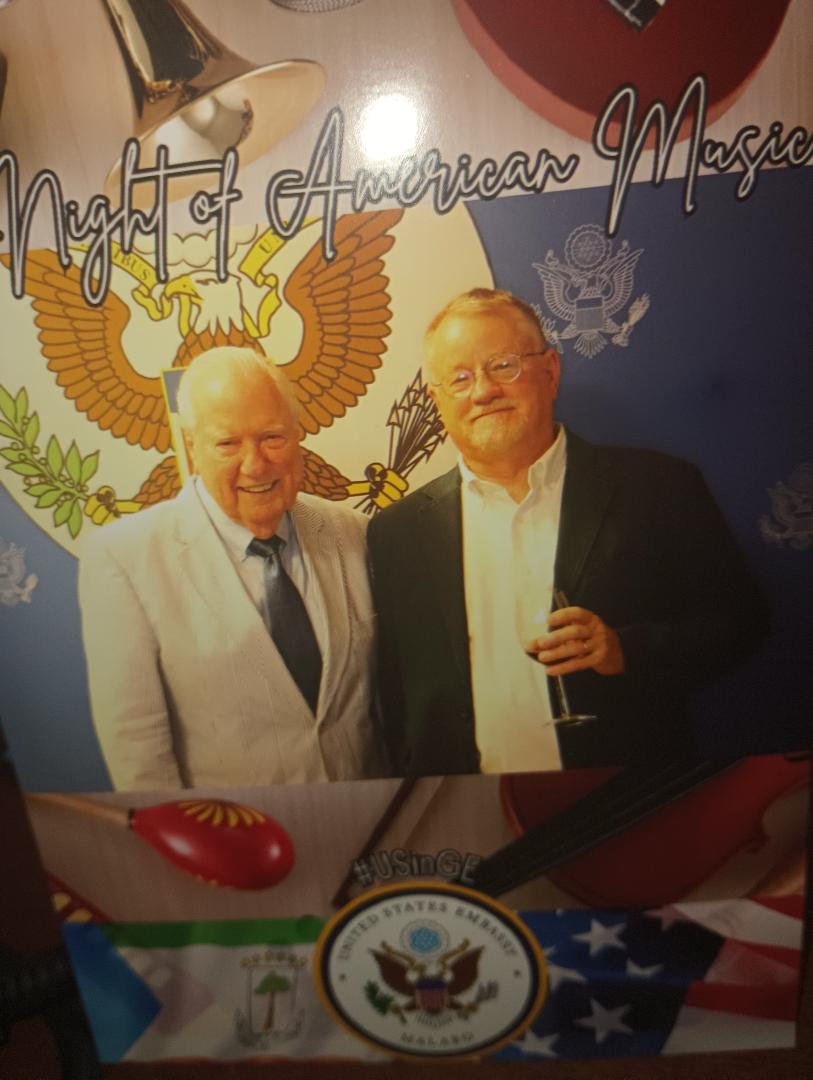

Chip and I at Ambassador's Representation

Ambassador's Residence
                                                                                                     event celebrating American Music

There are several oil companies in Malabo engaged in oil and gas development and production among them Chevron, Mobil and Marathon.  On Friday evenings embassy staff were always invited out to the main oil refinerery at Punta Europa for Happy Hour drinks and buffet dinner.  I don't believe I missed one Friday night the whole time I was there.  

I was only able to travel out of Malabo a couple of times to see some of the country.  Chip, Randy and I visited the Moka wildlife center located along the coast about 50 miles from Malabo.  After visiting the wildlife center we took a hike into the dense forest in the rain. 


Saturday, May 6, 2023

Yorktown Volunteer Trip 2023


Our tour on March 14-16 included the Battleship North Carolina in Wilmington, NC; The U.S. Army Airborne Museum in Fayetteville, NC and the U.S. Army Basic Combat Training Center near Columbia, SC.  We overnighted in Wilmington and Columbia and travelled a total of 550 miles in three days.

The Battleship North Carolina was the most highly decorated American battleship of World War II. North Carolina participated in every major naval offensive in the Pacific theater of operations earning 15 battle stars.  It was commissioned in April 1941.  

 
One of nine 16" gun mounts 

One of three Vought Kingfisher Scout Float Planes used  for aerial reconnaissance  


The ship was equipped with a battery of
 sixteen 1.1 inch anti-aircraft guns 

The ship also had 18 50-caliber machine guns


We received an initial briefing from a docent.


We were divided into groups and led on a tour


We toured nine levels of the ship


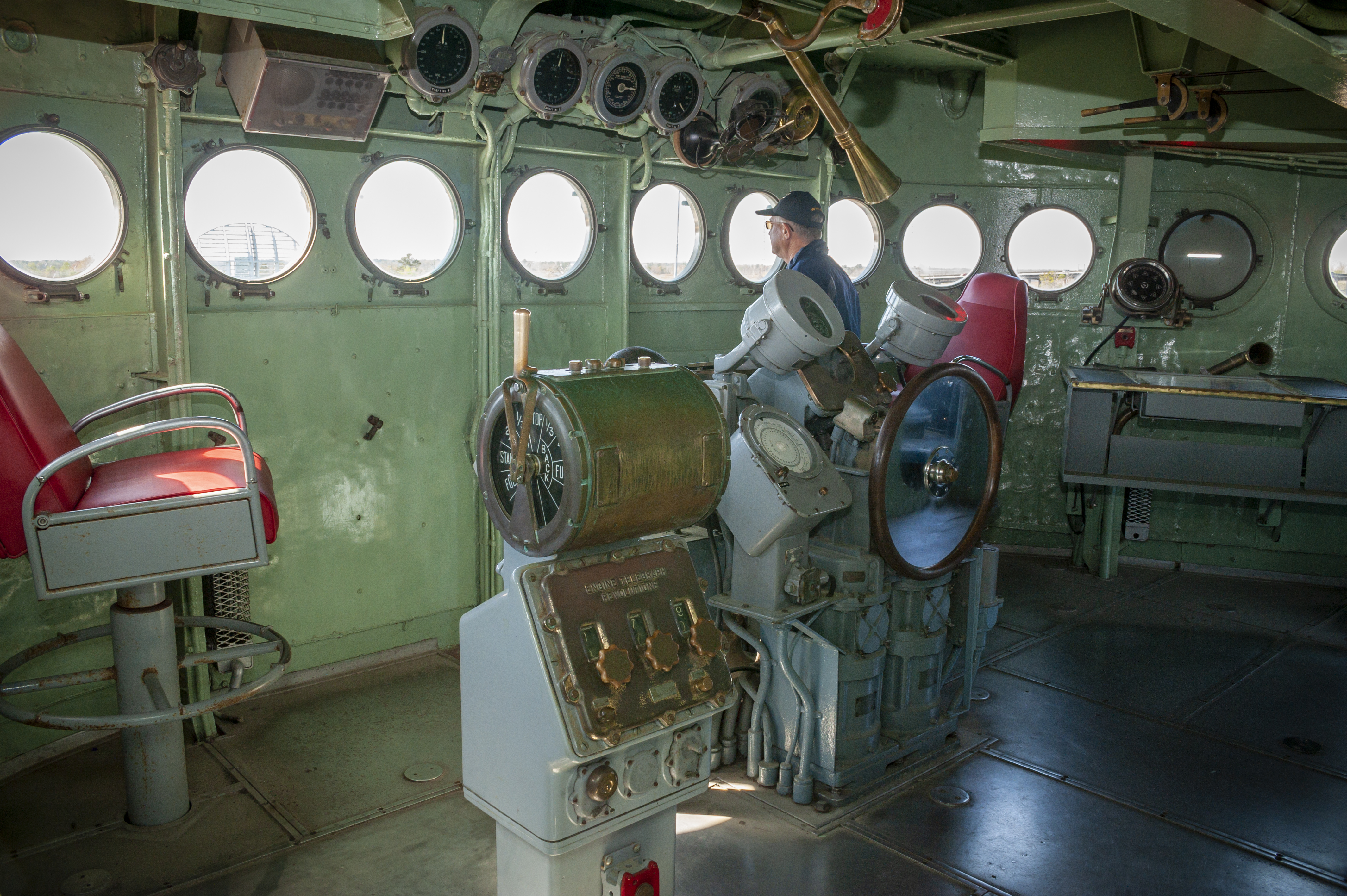
Including the Bridge
        
Crews Quarters


Radar room
The engine room

The rammer loads six powder bags into the gun.  The primer man then inserts the primer in the last bag which provides the spark to ignite the powder bags that fired the projectile out of the gun.    The men then closed the breech and turned on the ready light to signal to the turret officer that the gun was ready to fire.  The entire process takes only 30 seconds.     


Chow Line


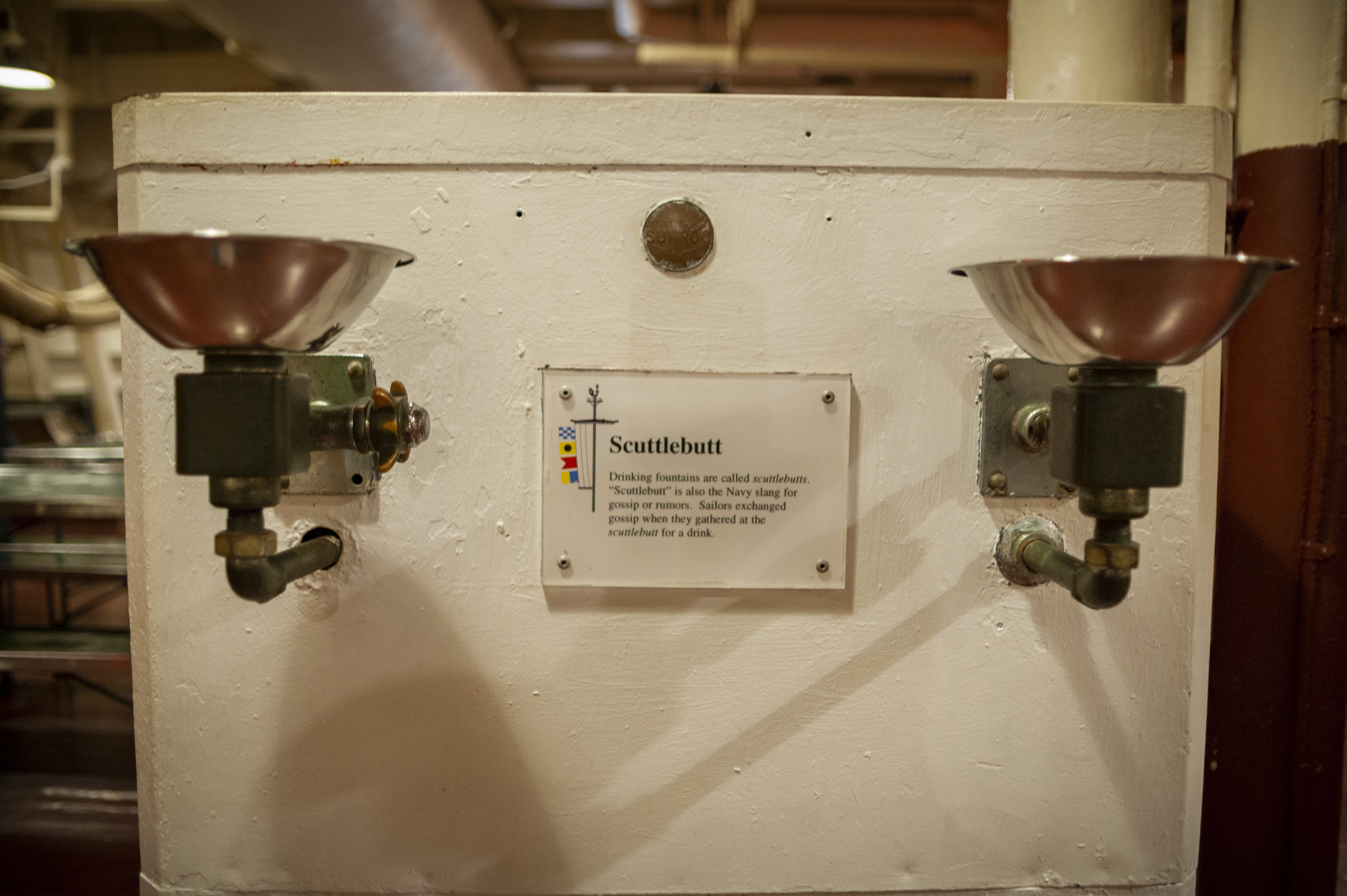
"Scuttlebutt"  was the drinking fountain on the 
Vegetable Prep

                                                                                         ship where sailors would exchange rumors on                                    the voyage. 

All 36 volunteers on the trip

On arrival at the U.S. Army Airborne Museum in Fayetteville
 in front of the statue of Iron Mike.  

Paratrooper suspended in air at the entrance

The Airborne Trooper.  The inscription on the base reads "Iron Mike, in honor of Airborne Troopers whose courage, dedication and traditions make them the world's finest fighting soldiers". 

We witnessed a reenlistment ceremony upon arrival

The exhibits included scenes from WWII, Korean War, Vietnam,
 Afghanistan and the Global War on Terror.  Operation Torch  (November 8-16 1942) was an allied invasion of French Africa. Torch was a compromise operation that met the British objective of securing victory in North Africa while allowing American armed forces the opportunity to engage in the fight against Nazi Germany on a limited scale.

Established in 1918, the 101st Division was first constituted as an airborne unit in 1942.] During World War II, it was famous for its role in Operation Overlord (the Airborne D-Day landings in Normandy on 6 June 1944),  Operation Market Garden; the liberation of  the Netherlands; and its action during the Battle of the Bulge around Bastogne, Belgium. During the Vietnam War, the 101st Airborne Division fought in several major campaigns and battles.  In mid-1968, the division was reorganized and redesignated as an airmobile division; in 1974, as an air assault division. The titles reflect the division's shift from airplanes to helicopters as the primary method of delivering troops into combat.  At the height of the War on Terror the 101st Airborne Division (Air Assault) had over 200 aircraft.


Airborne lands in Anzio and makes the way to Salerno

The Military Assistance Command, Vietnam known as Red Hats were technical advisors
to the Vietnamese Airborne.  They also fought along with their Vietnamese 
counterparts in Hue and the Tet offensive.

M.A.S.H. units (Mobile Army Surgical Hospitals) used in the Korean War were not practical for the jungles of Vietnam.  M.A.S.H. units travelled with the fight, but Vietnam was a different kind of war.    This was jungle fighting or guerilla warfare with many battles being relatively small and Huey helicopters were the primary source of travel.   The ratio from Killed In Action to surviving wounded in WWII was 29%, and in Vietnam 19%.  Forty-two per cent of Americans wounded in Vietnam were able to return to active duty.   

Examples of Airborne Poster Art

On the way to Columbia we had to stop at the world famous Bucee's in Florence, SC.

 
For dinner we had a choice of going to the Golden Corral buffet or the Bonefish Grill.  We selected the Bonefish.  With my fellow volunteers Paul Watters, Navy Pilot; Don  Bonamarito, USMC and Major Stoney Bates, USMC.


On arrival at Fort Jackson we were met and escorted by Drill Sergeant Gipson.
    Fort Jackson, is the U.S. Army's main production center for Basic Combat Training. The installation trains roughly 50 percent of all soldiers and more than 60 percent of women entering the Army each year.  Accomplishing that mission means training 46 weeks a year over 45,000 basic training and 12,000 additional advanced training Soldiers every year.  

Army Infantry trainees lined up to prepare to climb the Victory Tower.

Trainees on the rappelling tower

Victory Tower

SGT Gipson told me that 25% of trainees are foreign born.  A 2002 Executive Order made noncitizen members of the armed forces eligible for expedited U.S. citizenship.  Sixteen per cent of the U.S. Army is female.