Monday, June 10, 2002

Zagreb, Croatia

Overview:

Croatia's declaration of independence in 1991 was followed by four years of war and the best part of a decade of authoritarian nationalism under President Franjo Tudjman.  By early 2003 it had made enough progress in shaking off the legacy of those years to apply for EU membership, becoming the second former Yugoslav republic after Slovenia to do so.  Following protracted accession talks, Croatia took its place as the 28th member state of the EU on 1 July 2013.  A country of striking natural beauty with a stunning Adriatic coastline, Croatia is again very popular as a tourist destination. Moderate conservative Kolinda Grabar-Kiratovic was elected Croatia's first female president in January 2015, narrowly beating Social Democrat incumbent Ivo Josipovic in a run-off vote.  She pledged to kick-start the country's ailing economy.  She had previously served as foreign minister, ambassador to the United States and NATO assistant secretary-general.  The role of president is largely ceremonial. The president proposes the Prime Minister but it is for parliament to approve the nomination. 

Source:  BBC Country Profile

American Embassy Zagreb:

Embassy Zagreb is a midsized mission involving 11 agencies.   The DCM was Patrick Moon who went on to become Ambassador to Bosnia and Herzegovina.  In the final exit briefing, where the final field draft of the OIG report is reviewed with normally the Ambassador and DCM, and on occasion the entire senior staff, the DCM took exception to some language I had written about representation, which, if I recall correctly, I omitted or changed.  The Management Officer was Dorothy Sarro very capable administrator. I had an interesting exchange with Dorothy regarding our team arrival coinciding high-level visitors the same week.  She wanted to make sure that Marshall was invited to the Charge’s for dinner with the visiting Assistant Secretary for EUR, Beth Jones and General Charles Williams the head of the Office of Overseas Buildings (OBO).  Lt. General Williams had a distinguished military career as the head of the Army Corps of Engineers and spent seven years heading up OBO.   Norman Thatcher Scharpf held the combined FMO/HRO position, which was strange to me depending on the background and expertise of the individual.  My first exposure to such a position   I did stop at FSC/Paris in route to post for consultations and hooked up with my former colleague Don Simmons, USDO. 

Findings:

A major project affecting the embassy's future operations is the ongoing construction of a new New Embassy Compound (NEC) due to be completed in 2003. Planning for that move and its implications for overall U.S. operations occupies much of management's attention.   The embassy needed to explore ways to increase the amount of usable warehouse space on the new embassy compound and consolidating USAID office space.  Formal proposals should be vetted with the Bureau of Overseas Buildings Operations and the International Cooperative Administrative Support Services (ICASS) council. There were examples of unauthorized commitments for the NEC project that needed to be adjudicated and ratified.  Also, OIG found examples of improper certification of vouchers from the contractor.  Both of these issues required internal controls to be established to prevent a reoccurrence.  There was also confusion over who is responsible for the NEC contracting be the Bureau of Overseas Buildings Operations (OBO) or embassy General Services Office (GSO) which needed to be clarified.  The NEC was located out in the suburbs, quite a distance from downtown Zagreb and the old embassy.  It was unclear if there was even bus service for local staff.  There was also insufficient parking near the embassy compound for visitors to the consular section and employees.

There were 21 formal and 39 informal recommendations in the OIG report.  There were several problems with General Service Operations (GSO) which required recommendations in the report to be fixed including:  lack of separation of duties in keeping inventory records; the Real Property Application was not kept up to date.  The embassy pays utility costs directly to the city based on an unofficial meter, which is not approved by the city. GSO does not provide the housing questionnaires completed by new employees to the housing board before housing is assigned and there were issues with how housing was allocated. There were no written procedures for processing Blanket Purchasing Agreements and establishing obligations of funding with financial management.  

In terms of financial management services there were examples of inappropriate receipts and expenditures the suspense deposit abroad account that needed to be identified and paid or deposited into the U.S. Treasury.  The embassy should immediately start making U.S. dollar disbursements to U.S. direct-hire personnel via electronic funds transfer not by cash or check as mandated by the Government Performance a Results Act.  The accountable consular officer should submit the Monthly Consular Receipts report to the Management Officer, who should perform a monthly verification. The embassy does not maintain a centralized accounts receivable system for maintaining bills of collections as required by regulations.  There were several informal recommendations to improve internal controls in the area of cashier operations and automating issuing travel authorizations and processing vouchers.

Highlights:

  •   Sightseeing in Zagreb and shopping central market
  •   Trip to Plitvice National Park with Jim Martino while most of the other team members flew to      Split, on the Dalmatian coast, for the weekend.


Ban Lelacic Square or Republic Square

Early 12th Century Neo Gothic Cathedral of Zagreb

Central "Dolac" Market


 Plitvice Lakes National Park (Croatia). The Plitvice   Lakes National Park is UNESCO site, and one of the   highlights of Croatia. It is a truly natural wonder that   lies between Zagreb and the Dalmatian Coast, and is   famous for its crystal clear lakes, cascades,   waterfalls,  and pristine nature. At least two days are   necessary to fully explore the park with a camera.


Saturday, May 25, 2002

Ljubljana, Slovenia

Overview:

Slovenia is a small country in Central Europe, but contains within its borders Alpine mountains, thick forests, historic cities, and a short Adriatic coastline.  Slovenia was the first former Yugoslav republic to join the European Union, in May 2004 - shortly after joining Nato.  Unlike Croatia or Bosnia-Herzegovina, Slovenia's independence from Yugoslavia was swiftly won with relatively few deaths. The country also found the transition from a state economy to the free market easier than most.  Long regarded as one of the best-performing new EU members, Slovenia was dragged into a deep recession by the European financial crisis in 2012. This prompted mass protests at corruption and economic mismanagement by successive governments.  Prime minister of a centre-left government between 2008-12, Borut Pahor was was first elected president in December 2012.  He narrowly won re-election in November 2017, beating Marjan Sarec of the new LMS party. 

Source:  BBC Country Profile

American Embassy Ljubljana:

The inspection took place May 20 - 31, 2002.  The team consisted of Marshall P. Adair (team leader). Marshall was an experienced senior POL/ECON FSO who was a Deputy Assistant Secretary (DAS) in OIG and as a DAS in EUR for Richard Holbrooke.  He served as the president of AFSA.   Frances R. Culpepper (Deputy); Kris McMinn (Management) Robert W. Mustain (CONS); and Jim Martino (DS).  Kris was one of the oldest serving OIG inspectors dating back to when she was the Executive Assistant to the IG Jacquelyn Bridges in the late 90’s.  Kris left the OIG last year and transferred to the A bureau working part-time so she could devote more time to her family.  Jim Martino came from the GAO and got involved with State by leading a study of the security following the 1983 embassy bombing in Beirut.  He joined the OIG in 1989.     

The Ambassador was Johnny Young a Career Minister who had a long and distinguished 37 year career at State.  He started as a Budget & Fiscal Officer in Antananarivo, Madagascar in 1967.   He was Administrative Counselor in Bridgetown, Barbados in 1979 and Amman, Jordan in 1983.  He served as Ambassador to Sierra Leone, Togo, and Bahrain.  Slovenia was his final assignment.  In retirement Ambassador Young served as the Executive Director of United States Conference of Catholic Bishops.  His autobiography “Projects to the Palace:  A Diplomat’s Unlikely Journey from the Bottom to the Top” was published in 2013.   He and his wife Angelena were very outgoing.  I remember being at a local concert when they showed up with not a lot of fanfare.  The Management Officer was John Lipinski, who seemed very suspicious of OIG at first but later realized that we were no threat but there to help him address problems.  He was very helpful in arranging our separate arrivals, hotel accommodations at the Grand Union and onward two and a half hour travel by train to Zagreb.               

Findings:

The quality of regional coverage received by Embassy Ljubljana varies. Frankfurt’s Regional Support Center (RSC) Reginal Financial Management Officer, Charlie Eaton was adequate.  Carolyn Creevy, Regional Human Resources Officer (HRO) was helpful but needed to schedule more frequent visits; to facilitate communications with HR/Office of Overseas Employment (OE) for changes to the Local Compensation Plan and incorporate the newly developed Computer Aided Job Evaluation (CAJE) system in HR.   Assessments of the regional medical office coverage vary, although very good local health facilities help the embassy cope with medical issues.  

The mission occupied four sites throughout the city of Ljubljana. The GSO and community liaison office (CLO) are housed in the mission annex two blocks away from the chancery. The United States Customs regional export and border security facility is next door to the annex. The office of defense cooperation and the military liaison team are located at the Ministry of Defense. The embassy would like to consolidate all mission operations in one compound by purchasing the two properties adjacent to the chancery - the Russian embassy to the west and the nursery school to the south. OIG agreed that consolidation of all operations would, in principle, help to meet Department standards for both security and efficient operations. The cost of purchasing either of these two properties is too high to be justified at this time solely to consolidate operations.

In General Services Office (GSO) procurement contract folders including Blanker Purchase Agreements were not administered or organized as required by Department of State Acquisition Regulation.  Official vehicle inventory records to not distinguish which are International Cooperative Administrative Support Services Council (ICASS) and those that are Program develop a plan to reduce the overall number of vehicles. The Daily Vehicle Usage Report completed by Drivers did not sufficiently document the purpose of a trip nor obtain signatures of passengers, as required.

In the area of HR, OIG suggested that the administrative officer and HR specialist, in coordination with the FSN committee, develop a proposal to revise the mission local compensation plan to address the changes in the local labor laws in coordination with HR/OE.  Mission management should be more proactive in encouraging supervisors to recognize employee’s performance maintain open channels of communication and  encouraged more dialogue between the FSNs and mission management.

Formal recommendations in financial management included recommendations to:

  • Install the Travel Manager program, arrange for training staff and issue an administrative instruction on preparation and submission of vouchers.
  • Require the Accountable Consular Officer to forward the monthly summary of the daily accounting of consular fee receipts to the administrative officer for verification with cashier collections.
  • Improve coordination between the Public Affairs section and FMO on grants management for funding, monitoring and close out.  
  • Issue a mission-wide administrative directive to ensure that overtime is requested and approved in advance.

Highlights:

  •   Quaint downtown Ljubljana
  •   Ljubljana Castle
  •   Train to Trieste and visit to Miramare Castle

River Ljubljanica first spanned by bridge in the Roman period.


Downtown Ljubljana


  Ljubljana Castle


Center City Trieste

Some of my colleagues went to visit San Marino, a four and half hour train ride from Ljubljana.  I decided to take the train to Trieste, which was two and a half-hour train ride and besides visiting the Miramar Castle I had a wonderful seafood meal on the coast.    

Trieste is a seaport city in northeastern Italy.  It is a narrow strip of Italian territory lying between the Adriatic Sea and Slovenia and 19 miles from Croatia to the south.   Trieste is at the head of the Gulf of Trieste and has a very long coastline. In 2018, it had a population of about 205,000 and it is the capital of the autonomous region Friuli Venezia Giulia.  Trieste was one of the oldest parts of the Habsburg Monarchy from 1382 until 1918. In the 19th century the monarchy was one of the Great Powers of Europe and Trieste was its most important seaport. As a prosperous seaport in the Mediterranean, Trieste became the fourth largest city of the Austro-Hungarian Empire (after Vienna, Budapest and Prague.


 Miramar castle and park built by Archduke   Maximillian for his bride the Princess
 Charlotte of Belgium before he went off to his   death as the Emperor of Mexico. It's a     beautiful castle, in a rustic setting with a large   park surrounding it. It's well worth
 a visit.


Saturday, March 30, 2002

Capetown, South Africa

Highlights: 
 
  •     Cape Town waterfront
  •     Panama Jacks Restaurant
  •     Stellenbosch Winery Tour
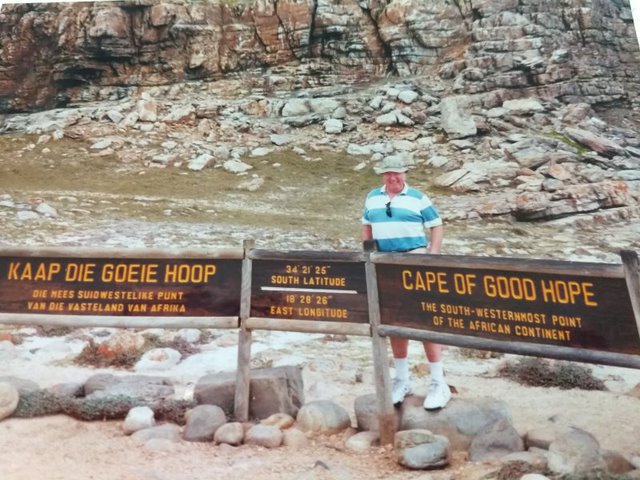
  •     Cape of Good Hope
  •     Penguins on the coast 


Waterfront in Cape Town

Cape Town City Hall

Coastline with Table Mountain in the distance

The Cape is not actually the southern tip of Africa and dividing point between the Atlantic (warm water) and Indian (cold water) oceans, it's actually 90 miles east-southeast  at Cape Agulhas.

OIG Team:  Ambassador Bob Barbour, Carl Troy, Arne Baker, Andrea Leopold and Fran Culpepper on excursion in Cape Town

Boulders Penguin Colony.  African penguins are on the verge of extinction are under the protection of the Cape Nature Conservation. 

Visit to Wineries in Stellenbosch South Africa's most famous wine producing region.

Best known for the quality of their Cabernet Sauvignon, Merlot and Bordeaux blends.


Friday, March 15, 2002

Windoek, Namibia

Namib Desert 
Sossuselvi Dunes


Overview:

Namibia, a large and sparsely populated country on Africa's south-west coast, has enjoyed stability since gaining independence in 1990 after a long struggle against rule by South Africa.  Germany took control of the area which it called SouthWest Africa in the late 1800s.  The discovery of diamonds in 1908 prompted an influx of Europeans. South Africa seized it during the First World War and administered it under a League of Nations mandate.  Hage Geingob was voted in as president in the November 2014 elections while serving as prime minister.
Source: BBC Country Profile

American Embassy Windhoek:

The inspection took place from March 8 - 22, 2002, which included a layover on the 7th in Johannesburg from on our flight from Luanda.  I was still a relatively new inspector and had my first encounter with a young Management Officer, Mike Raynor, during a counseling session on treatment of an FSN and his micromanagement style.  I had hoped that he would modify his management style.  Apparently, he changed his ways as Mike went on to be the Africa bureau Executive Officer and Ambassador to Ethiopia.    The FMO/HRO was Bryan Ermantinger who ended up working with me at CGFS/BKK and is now a senior FMO in Ottawa.  A lot of small embassies have combined FMO/HRO positions, which isn't ideal.  Almost always one of the sections ends up not getting as much supervision and oversight as required.    

Findings:

    ·       An ongoing chancery renovation is the embassy's biggest administrative problem, completely                 consuming the time of a facilities maintenance manager who also has regional responsibilities.               These regional responsibilities should be removed.

·       The financial management/human resources officer also has regional duties, but there is no inter-embassy memorandum of understanding to govern them.

·       The regional information management specialist should be converted to a full-time position to serve exclusively in Windhoek.

·       There were weaknesses in cashier controls and time and attendance reporting.  


OIG Team Ambassador Bob Barbour, Team Leader; Carl Troy, Andrea Leopold, Arne Baker, Fran Culpepper.  Arne Baker went on to become the Deputy Assistant Inspector General for Inspections in February 2021.  Carl Troy arranged for our excursions outside of Windhoek on the weekends.

Favorite Memories:
  •  Visit to Etosha game park and Kenpinski Mokuti lodge with variety of animals including   Springbok, Impala, Wildebeast, Oryk, Jackals,  Antelope, and Black Rhino
  •  Trip to Swaakopmund, Skeleton coast and the Sand dunes at Sossusvlei in the Namib desert
  •  Site of filming of Angelina Jolie movie “Beyond Borders”

                         Mukuti Lodge, Etosha game park


 Swakopmund (sfä'kĂ´pmÉ™nt), municipality (1991   pop. 17,681), W Namibia, on the Atlantic at   mouth of Swakop River. A rail terminus and   seaside resort surrounded by the Namib desert,   the town was originally a port for German South   West Africa, but the harbor silted up and was   supplanted by Walvis Bay after 1915. There is a   strong German architectural influence in the town,   which has many Bavarian-style buildings. There   are salt, garnet, and uranium deposits in the   region. Founded in 1892 by German settlers.


Coastline
 
Sea Lions at Skeleton Coast

Wednesday, March 6, 2002

Kinshasa 2002

Overview:

The recent history of the Democratic Republic of Congo (DR Congo) has been one of civil war and corruption.   DR Congo is a vast country with immense economic resources and, until recently, has been at the center of what some observers call "Africa's world war", with widespread civilian suffering the result.  The war claimed an up to six million lives, either as a direct result of fighting or because of disease and malnutrition.  The war had an economic as well as a political side. Fighting was fueled by the country's vast mineral wealth, with all sides taking advantage of the anarchy to plunder natural resources.  Some militias fight on in the east, where a large United Nations force is struggling to keep the peace. Opposition leader candidate FĂ©lix Tshisekedi became president in January 2019 after protracted political wrangling in the wake of a controversial election the previous month. 

Source: BBC Country Profile

American Embassy Kinshasa:

The inspection took place between February 20 and March 6, 2002.  Bob Barbour replaced Fred Rondon as our Team Leader.  Bob was from Memphis, Tennessee, had served as Ambassador to Suriname and before that Madrid and Paramaribo as DCM.  He had three postings in Saigon and Hue.  He was gentle man and highly intellectual.  We both read detective Maigret crime novels by the French writer Georges Simenon (in French).  Bob passed away in February 2021, at the age of 94 in Vienna, VA.  

There were 51 U.S. direct-hire and 233 Foreign Service Nationals including local guards.  I ran into the issue of having local-hire guards versus contract guards on occasion.  OIG felt that there should be contract with a company to provide guard services as opposed to the embassy HR hiring and servicing guard salaries, benefits and allowances. The Management Officer was Margaret "Meg" Keeton who had a good reputation in AF.  I had an interesting consultation with Meg who complained about the Regional Security Officer (RSO) not attending admin staff meetings.  This was a recent bone of contention ever since the determination was made to have the RSO report to the DCM vice Management Officer in the late 90's.  She also didn't agree that local guards should be local-hire employees but under an umbrella contract.   The FMO was Tom Schmitz, an Admin Generalist on his first FMO tour and enthusiastic to learn.  The embassy for the Republic of the Congo was also housed with embassy Kinshasa because there was no official American presence in the capital Brazzaville.  This situation required regional HR and FMO support of local staff who commuted from Brazzaville   

Findings:

In the area of government-owned real property OIG recommended that the embassy dispose of two underutilized residential properties and a vacant lot. The senior local-hire GSO property supervisor was under investigation for diverting furniture an equipment form the warehouse.  Also, for facilitating the submission of bogus bids for sale of property and then selling to friends at reduced prices.     

Overall management needed to urge the International Cooperative Administrative Support Services (ICASS) council and the working group to work more closely with other agencies and define uniform service standards.

Human Resources was headed by German national, Helga Muller, a long-time well regarded PSC.  Better coordination was needed with HR/OE to review its Foreign Service national benefit plans and continue to monitor the situation with respect to salary surveys. A policy on use of overtime needed to be issued reminding staff that all overtime must be approved in advance.   An alternative hiring mechanism for English language teachers that meets legal requirements needed to be established that protects against potential liability claims.

There should be a memorandum of understanding with Embassy Brazzaville summarizing the regional financial management officer’s and human resource specialist’s responsibilities and establish a schedule of visits when Embassy Brazzaville resumes operations. There was an outstanding fiscal irregularity involving the previous cashier code that needed to be cleared.

Highlights:
  • Not much to do in Kinshasa given security concerns but walk around the area of the Grand Hotel and along the Congo river.  We did find a local Lebanese restaurant that we frequented for lunch.   

Ambassador's residence located along the Congo river where I walked past most every day.